Co-create
Conversations are built by everyone in them. Week one starts here: how meaning gets made between people rather than delivered at them.
A two-week course with Jana Dawson, Deputy CEO of The School of Positive Psychology. Learn the CARE model — a four-part method for the conversations that decide how connected people feel, at work and at home.
2 weeks · 10 lessons · 2 hours · certificate · lifetime access
Join now for $99.9948-hour money-back guarantee · Secure checkout · Instant access
Most communication advice is a pile of tips. This course teaches a single framework — the CARE model of Positive Communication — one element at a time, so you leave with something you can actually recall mid-conversation.
Conversations are built by everyone in them. Week one starts here: how meaning gets made between people rather than delivered at them.
What it takes for someone to feel heard — and why acknowledgement, not agreement, is what makes hard conversations survivable.
Frankl's space between stimulus and response, applied to the moment you are about to say something you cannot take back.
How encouraging others to succeed changes what they bring you next time — the compounding part of the model.
Evidence-based concepts from the field Jana teaches at postgraduate level, translated into habits rather than theory.
The research idea behind the course: short interactions can measurably strengthen or drain a working relationship.
Recognising how differently people send and receive, so you stop mistaking a style difference for a disagreement.
Communication is the one skill nobody formally taught us, and the one everything else rests on.

You know what you want to say afterwards. In the moment, you either go quiet or say the wrong version of it.
You are listening. It is not landing that way, and you are not sure where the gap opens up.
Plenty of exchanging information, not much actual connection — and collaboration suffers for it.
Different words, same shape, no resolution. Something structural is going wrong and tips have not fixed it.
Communication can be difficult, particularly during conflict — and it is also learnable. Two weeks and a single framework are enough to change how the next difficult conversation goes.
Positive communication is the foundation of every lasting relationship. There is far more to it than exchanging information — it is what determines the quality of the connection on the other side.
Build the kind of interactions that strengthen collaboration rather than quietly eroding it.
Say things in a way that creates validation rather than defensiveness — including when the news is difficult.
Understand diverse communication styles and set the conditions for a positive exchange before it starts.
The motivation and self-assurance to make the most of the relationships you already have.

This is not about being relentlessly upbeat. Positive communication means constructive, effective and supportive — the version that holds up in a disagreement, not just on a good day.
Join now for $99.99
Jana is a leading advocate for well-being and positive psychology education in Asia. As Deputy CEO and Director of Academic and Training Development at The School of Positive Psychology in Singapore, she designs and delivers the evidence-based programmes that help individuals, teams and organisations thrive.
Her degree is in communication and her master's is in applied positive psychology, which is precisely the pairing this course needs. Over more than a decade she has specialised in resilience, strengths-based development and positive organisational psychology, working with Standard Chartered, Meta, SingTel, PayPal, A*STAR and the Singapore Prison Service. She works from the belief that when individuals flourish, society flourishes.
Jana has run workshops, keynotes and coaching programmes for Standard Chartered, Meta, SingTel, PayPal, A*STAR and the National Heart Centre Singapore, reaching thousands of people.
At The School of Positive Psychology she leads academic and training development, and lectures on introduction to positive psychology and strengths development.
Feedback, difficult news and day-to-day collaboration all come down to how you say things.
If disagreement makes you go quiet or overcorrect, the model gives you somewhere to stand.
The same four elements work at the kitchen table. This is not only a workplace skill.
Where trust is the product, the quality of each interaction is the whole relationship.
A shared vocabulary for how people talk to each other is the cheapest culture change available.
No prior knowledge of positive psychology needed. The course starts from the beginning.
Built to fit a working fortnight: 10 short lessons with expert videos, a daily task with each one, two hours of on-demand learning and lifetime access to the videos and notes. A certificate of completion comes with it.
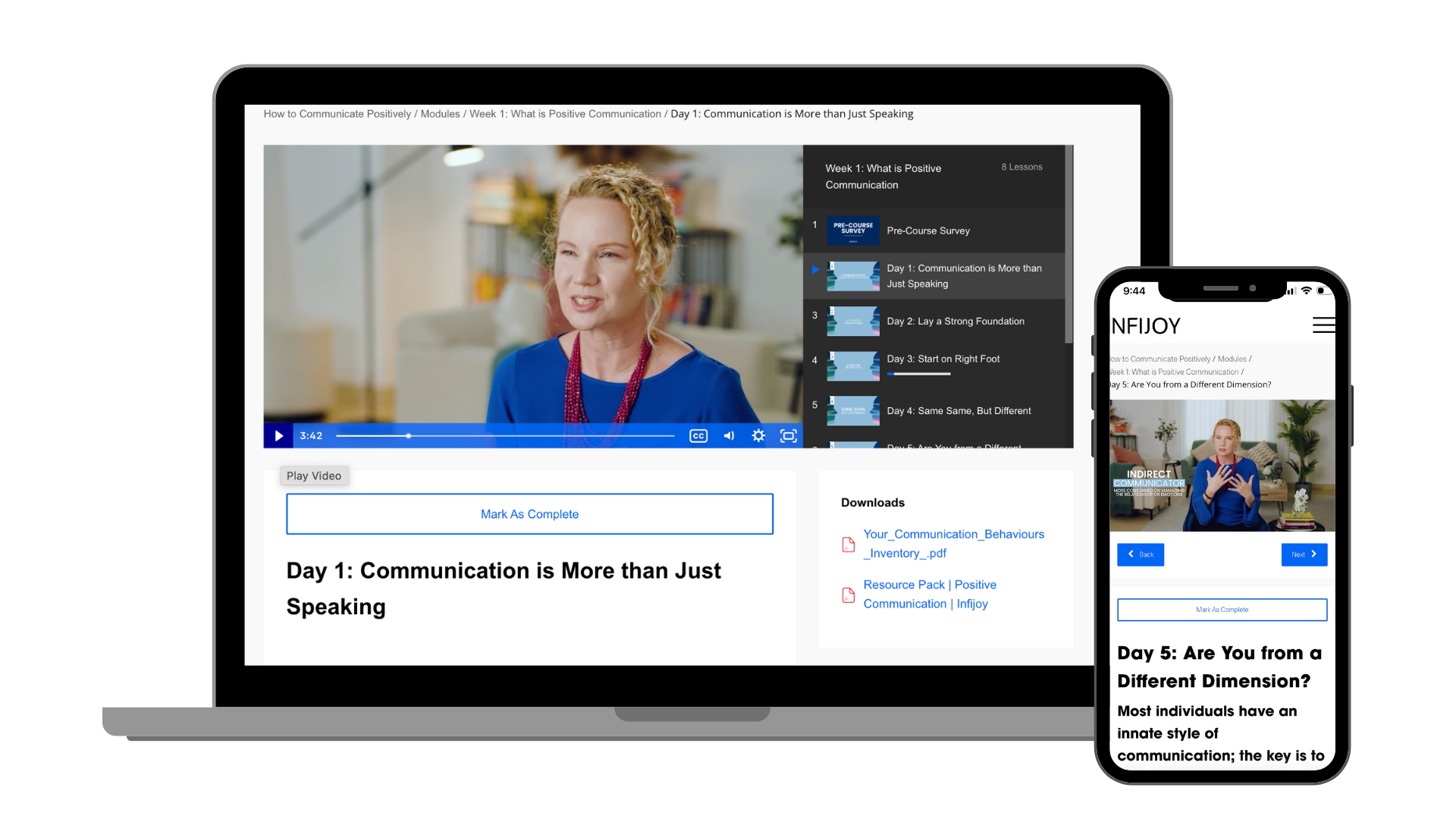
Week one builds the understanding and covers the first half of the CARE model. Week two takes on the harder half — what you do in the moment between being provoked and replying.
A single message can change how you feel, how connected you are to the person who sent it, and whether the day counts as a good one. This week unpacks that power, builds a working definition of positive communication, and introduces the first two elements of the CARE model — Co-create and Acknowledge.
Viktor Frankl, the founder of logotherapy, described a space between stimulus and response, and located our freedom in what we choose to do with it. Positive communication asks you to hold that space open and answer in a way that brings out the best in everyone present. This week covers the remaining elements — Respond and Encourage.
If within the first two days you feel this is not the right fit, email support@infijoy.com and we will refund your enrolment fee in full — no questions, no forms.
Buy How to Communicate Positively outright, or join Infijoy membership for all 37 expert-led courses.
48-hour money-back guarantee · Instant access
$299.99 billed yearly · Cancel anytime · 7-day guarantee
Still unsure? Email support@infijoy.com and we will answer.
A four-part framework for positive communication: Co-create, Acknowledge, Respond and Encourage. Week one covers the first two elements, week two the second pair. Teaching one model rather than a list of tips is what makes it possible to actually use mid-conversation.
Two hours of on-demand learning in total, spread across ten short lessons over two weeks. Each lesson comes with a daily task designed to fit into your existing routine rather than compete with it.
Both. Positive communication underpins every sustainable relationship, professional or personal, and the course is built to be applied in both directions. The examples span workplace collaboration and the conversations you have at home.
Yes. Start the course whenever you are ready and work through it at your own pace. Lifetime access means you can revisit a lesson or restart a week at any point.
Across the two weeks you will learn how to:
No — the opposite. Positive communication is constructive, effective and supportive, which includes disagreement and difficult feedback. Communication is hardest during conflict, and that is exactly where the model is meant to hold.
None. No background in positive psychology or communication theory is assumed. The course starts by building the concepts from scratch.
Jana holds an MSc in Applied Positive Psychology from Anglia Ruskin University, a Postgraduate Diploma in Positive Organisational Psychology and Leadership, and a Bachelor's degree in Communication from the University at Buffalo. She is Deputy CEO and Director of Academic and Training Development at The School of Positive Psychology in Singapore, with over a decade of experience across resilience, strengths-based development and positive organisational psychology.
Lifetime access to all ten lessons and the accompanying notes, so you can return whenever you need a refresher.
No. This is educational well-being content covering communication skills and everyday habits. It is not therapy, relationship counselling, or a substitute for care from a qualified professional.
Join How to Communicate Positively and spend a fortnight learning one framework properly — the four elements that decide whether people leave a conversation feeling closer to you or further away.
48-hour money-back guarantee · Secure checkout · Instant access