
Research & Evidence Behind Infijoy
A research-led, integrative approach to wellbeing, learning, and human development

Infijoy Methodology: Research & Theoretical Foundations
Infijoy’s educational methodology is grounded in established psychological theory, behavioural science, and contemporary learning research. Our courses are designed around a central premise supported by decades of academic literature: sustainable wellbeing and behavioural change emerge through structured, evidence-informed processes that respect human motivation, cognition, emotion, and neurobiology.
Rather than positioning wellbeing as a matter of willpower, positivity, or short-term motivation, Infijoy adopts a research-led and integrative approach. This ensures learning is not only intellectually robust, but also psychologically safe, developmentally appropriate, and capable of long-term integration into daily life.
Positive Psychology and the Empirical Study of Wellbeing
Infijoy draws extensively from the field of positive psychology, which examines the conditions under which individuals and communities flourish. Unlike deficit-based models that focus primarily on pathology, positive psychology investigates strengths, meaning, engagement, and psychological resources that support resilience and life satisfaction.
Longitudinal and experimental research in this field demonstrates that wellbeing is not a fixed trait, but a dynamic capacity that can be intentionally developed. Empirical studies suggest that intentional wellbeing interventions may account for approximately 30–40% of variance in reported life satisfaction, while consistent practices such as gratitude, purpose alignment, and strengths utilisation are associated with measurable improvements in emotional regulation and stress resilience.
Infijoy courses operationalise these findings by translating theoretical constructs into structured learning sequences. Educational content is combined with reflective practices and applied exercises designed to strengthen self-efficacy, emotional awareness, and meaning-oriented goal formation. The emphasis is not on superficial positivity, but on cultivating psychologically sustainable internal resources.
Longitudinal and experimental research in this field demonstrates that wellbeing is not a fixed trait, but a dynamic capacity that can be intentionally developed. Empirical studies suggest that intentional wellbeing interventions may account for approximately 30–40% of variance in reported life satisfaction, while consistent practices such as gratitude, purpose alignment, and strengths utilisation are associated with measurable improvements in emotional regulation and stress resilience.
Infijoy courses operationalise these findings by translating theoretical constructs into structured learning sequences. Educational content is combined with reflective practices and applied exercises designed to strengthen self-efficacy, emotional awareness, and meaning-oriented goal formation. The emphasis is not on superficial positivity, but on cultivating psychologically sustainable internal resources.
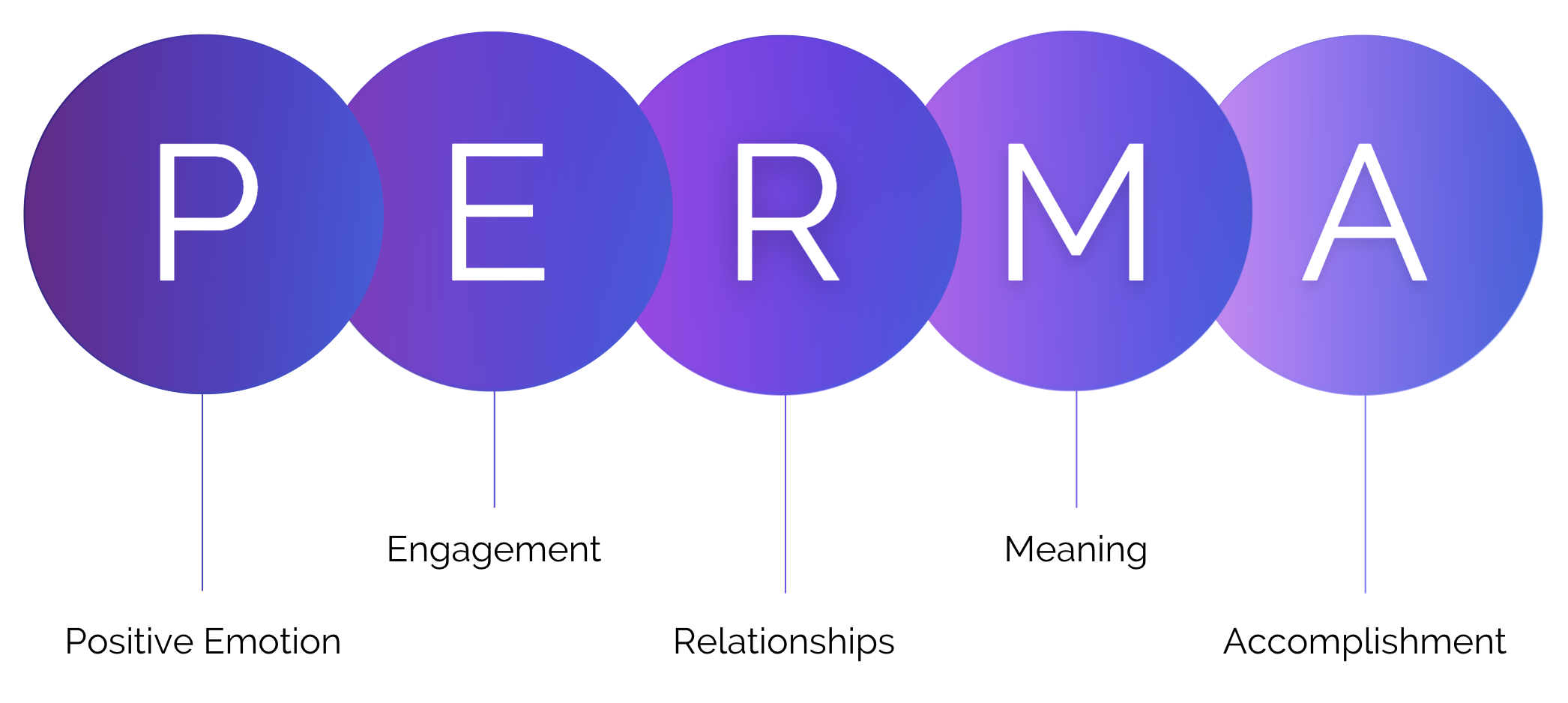
A central framework within positive psychology that informs Infijoy’s course design is the PERMA model, developed by Martin Seligman. The PERMA model conceptualises wellbeing as a multidimensional construct comprising Positive emotion, Engagement, Relationships, Meaning, and Accomplishment. Research supporting this model demonstrates that wellbeing is most effectively cultivated when these dimensions are developed in combination rather than in isolation. Infijoy courses reflect this multidimensional approach by addressing emotional experience, purposeful engagement, relational awareness, meaning-making, and goal-oriented progress across different learning pathways. This ensures that wellbeing is approached as a balanced and integrated process, rather than a singular outcome or emotional state.
Mental Health as a Continuum: Corey Keyes’ Model of Wellbeing
Infijoy’s approach to wellbeing is further informed by the work of Corey Keyes, whose research introduced the concept of mental health as a continuum rather than a binary state of “healthy” or “ill”.
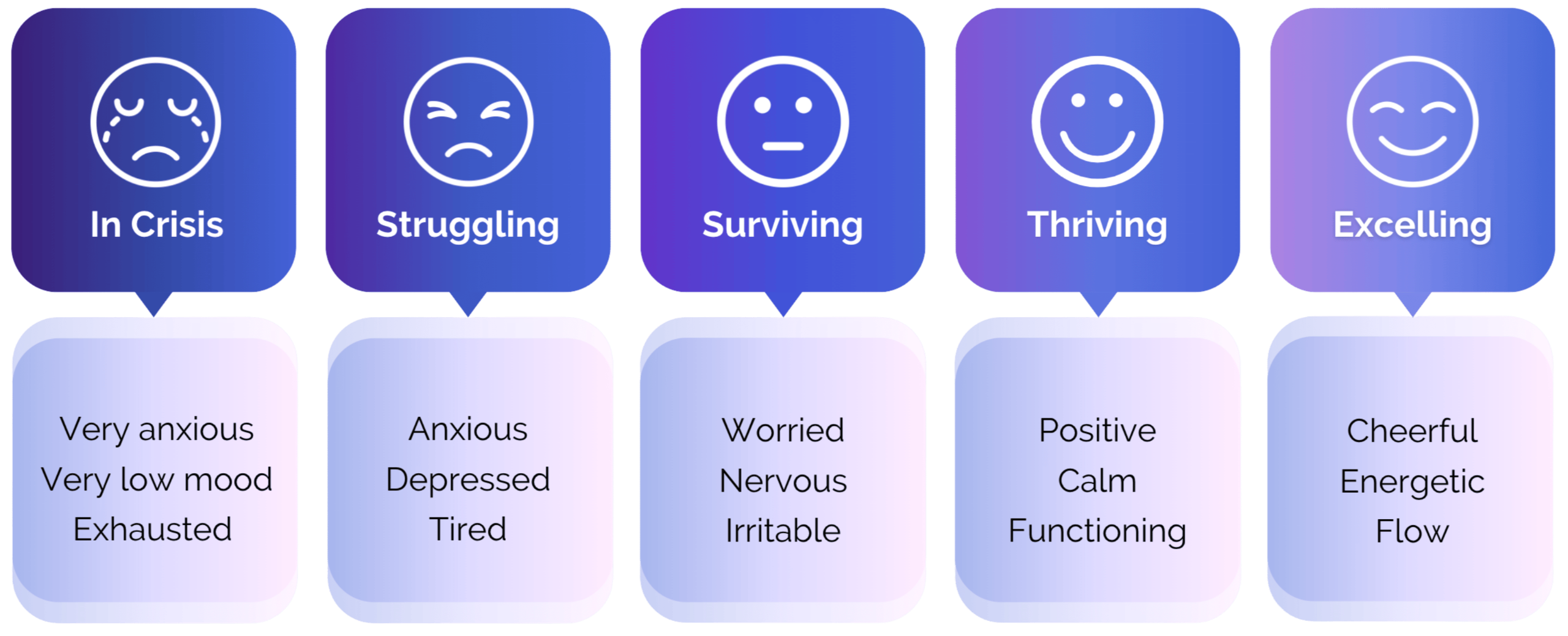
Keyes’ model distinguishes between the absence of mental illness and the presence of positive mental health. His research demonstrated that individuals can be free from diagnosable conditions while still experiencing low levels of wellbeing, disengagement, or emotional stagnation — a state he termed languishing. Conversely, individuals may experience challenges while still maintaining high levels of psychological functioning, purpose, and resilience — a state described as flourishing.
Large-scale population studies conducted by Keyes and colleagues found that flourishing is associated with greater emotional resilience, higher productivity and engagement, stronger social functioning, and a lower long-term risk of mental health deterioration.
This continuum-based understanding aligns closely with Infijoy’s educational positioning. Our courses are not designed to address pathology, but to support movement along the wellbeing spectrum — from stagnation toward engagement, meaning, and psychological vitality. This continuum-based understanding of wellbeing is visually reflected in the progression illustrated below, which depicts movement from states of crisis and struggle, through survival and functioning, toward thriving and excelling. Importantly, the continuum does not imply fixed categories or diagnoses, but rather recognises that individuals may move fluidly along different points over time, depending on internal resources, external circumstances, and available support. Infijoy’s courses are designed to support this natural movement along the spectrum by strengthening psychological resources, self-awareness, and adaptive capacity, rather than treating wellbeing as an all-or-nothing state.
Human Motivation, Development, and Maslow’s Hierarchy of Needs
The structural logic of Infijoy’s learning pathways is informed by classical humanistic psychology, particularly the work of Abraham Maslow. Maslow’s Hierarchy of Needs remains one of the most influential frameworks for understanding human motivation, learning readiness, and psychological development.
Maslow proposed that higher-order growth — including confidence, autonomy, creativity, and self-actualisation — is contingent upon the relative fulfilment of more fundamental needs such as safety, belonging, and self-worth. Contemporary research in educational psychology and organisational wellbeing continues to support this principle, demonstrating that learning, emotional regulation, and behavioural change are significantly impaired under conditions of chronic stress or perceived threat.
Infijoy reflects this developmental understanding by prioritising psychological safety and self-regulation before encouraging challenge or expansion. Courses are intentionally designed to reduce cognitive overload and self-judgment, enabling learners to engage with growth-oriented material from a stable and supported internal state.
Neuroscience, Neuroplasticity, and Behavioural Change
Contemporary neuroscience provides strong empirical support for the principle that the adult brain remains adaptable throughout life. This capacity for change, known as neuroplasticity, explains how repeated cognitive, emotional, and behavioural practices can produce durable neural reorganisation.
Research indicates that habit formation depends less on intensity and more on consistency, emotional relevance, and contextual reinforcement. Studies suggest that meaningful behavioural change typically requires six to ten weeks of sustained practice, with significant individual variation.
Infijoy’s pedagogical structure reflects these findings. Course content is delivered in concise, cognitively manageable segments, supported by repeatable practices designed to integrate into daily life. This incremental approach increases the likelihood of long-term behavioural adoption while minimising overwhelm.
Depth Psychology, Identity, and the Role of the Unconscious
While many wellbeing models focus primarily on conscious cognition, Infijoy incorporates principles from depth psychology to address less visible psychological processes that influence behaviour. In particular, our methodology is informed by the work of Carl Jung, whose research emphasised the role of unconscious patterns, identity formation, and psychological integration in long-term development.
Jung’s work highlighted that enduring behavioural and relational patterns are often maintained by unconscious beliefs, internalised narratives, and unexamined emotional responses. Without structured opportunities for awareness and integration, insight alone rarely produces sustained change.
Infijoy courses therefore include guided inquiry and reflective practices designed to support awareness of recurring patterns, internal conflicts, and identity-level beliefs. By facilitating conscious integration rather than suppression or avoidance, learners develop greater psychological coherence, flexibility, and self-understanding.
Non-Duality as an Integrative Psychological Framework
At a foundational level, Infijoy’s methodology is informed by the principle of non-duality, understood not as a spiritual doctrine, but as an integrative framework for human experience. From this perspective, psychological, emotional, behavioural, and relational challenges are not isolated phenomena, but interconnected expressions of a unified system of awareness, identity, and perception.
Non-duality recognises that the apparent separation between different areas of life — such as confidence, relationships, purpose, and wellbeing — is largely conceptual. Change in one domain therefore often produces effects in others, which explains why Infijoy offers courses across diverse topics while maintaining a coherent underlying methodology.
John Welwood: Integrating Duality and Non-Duality
Infijoy’s applied understanding of non-duality is strongly informed by the work of John Welwood, whose writing bridges contemplative insight and Western depth psychology. In Double Vision: Duality and Nonduality in Human Experience, Welwood articulated a psychologically grounded framework in which personal development and non-dual awareness coexist rather than compete.
Welwood emphasised that psychological growth does not require bypassing personal identity, emotion, or developmental history. Instead, he proposed a both-and model: recognising underlying unity while responsibly engaging with the relative dimensions of human experience. This approach addresses a critical gap in many wellbeing models that either overemphasise personal psychology or prematurely collapse it into abstraction.
Infijoy adopts this integrative stance by encouraging awareness without disengagement and engagement without over-identification. This supports psychological flexibility, emotional regulation, and adaptive behaviour across life domains.
Ken Wilber and Integral Theory: A Whole-System Perspective
Infijoy’s integrative methodology is further informed by the work of Ken Wilber, whose Integral Theory provides a comprehensive framework for understanding human development across multiple dimensions simultaneously.
Wilber’s model proposes that human experience unfolds across interconnected domains, including inner experience, observable behaviour, cultural context, and structural systems. Crucially, Integral Theory emphasises that development occurs across multiple lines — cognitive, emotional, moral, relational, and identity-based — and that progress in one area does not automatically imply progress in others.
This perspective aligns directly with Infijoy’s non-dual and integrative foundation. Rather than reducing wellbeing to mindset, habits, or emotion alone, Infijoy courses engage multiple dimensions of human experience in parallel — awareness, identity, behaviour, and context.
Integration Rather Than Reduction
Wilber’s work reinforces a central principle of Infijoy’s methodology: no single framework is sufficient on its own. Psychological wellbeing cannot be fully explained — or effectively supported — through purely cognitive, emotional, behavioural, or spiritual models in isolation.
Infijoy therefore treats positive psychology, **Abraham Maslow’s developmental theory, depth psychology, non-dual awareness, neuroscience, learning science, and continuum-based mental health models as complementary perspectives. Each describes a different aspect of the same underlying human system.
This integrative stance allows Infijoy to avoid both oversimplification and fragmentation, supporting learning that reflects the complexity of real human development.
Why Infijoy Covers Many Seemingly Different Topics
Infijoy’s breadth is intentional. From an integrative perspective, challenges related to confidence, relationships, purpose, emotional wellbeing, or self-regulation are not fundamentally separate problems. They are different entry points into the same underlying system of perception, meaning-making, and self-concept.
By offering multiple courses across diverse domains, Infijoy allows learners to engage where it feels most relevant. Progress in one area often produces secondary benefits in others — reflecting systemic change rather than isolated skill acquisition.
An Ethical and Educational Approach to Wellbeing
Infijoy exists to translate well-established psychological research into accessible, responsible, and human-centred learning experiences. Our courses are educational and self-development focused; they do not diagnose, treat, or replace medical or therapeutic care, nor do they guarantee specific outcomes.
By combining scientific rigour with reflective practice, Infijoy approaches wellbeing not as a trend or quick fix, but as a disciplined, learnable process grounded in research, ethics, and respect for individual complexity.