
Emotional Agility
Bouncing back from challenges, and the self-awareness that makes it repeatable.
A five-week course with Stephen Lew, psychotherapist and founder of The School of Positive Psychology, Asia's first institution dedicated to well-being. Twenty-five lessons on emotional fitness, awareness, connection and the habits that hold.
5 weeks · 25 lessons · 6 hours · certificate · lifetime access
Join now for $199.9948-hour money-back guarantee · Secure checkout · Instant access
Five weeks training the same muscle from five angles: knowledge, emotional fitness, awareness, connection and habits.
Bouncing back from challenges, and the self-awareness that makes it repeatable.
Emotional awareness through the body, plus a richer emotional vocabulary to name it with.
Reflection, reframing, diffusion and mindfulness, used to stop unhelpful thought patterns.
Interpersonal, intrapersonal and human-nature connection, and how to map your own resources.
The strategies that turn any of this into a routine you still have in six months.
Navigating difficulty with more confidence, which is where resilience is actually spent.
Much like physical strength, emotional and mental resilience are muscles. They can be strengthened, and they can be put to use when you need them most.

Recovery takes longer each time, and you have started to treat that as simply how you are.
You can hear it happening and cannot interrupt it, because nobody taught you the interrupt.
Exactly when judgment matters most, it is the thing that goes first.
Support exists but reaching for it feels like weakness, which is precisely backwards.
Resilience is not only about getting through. It is about tapping into your strengths and learning to support yourself well when things are hard, then building the daily habits that keep that capacity available.
The course develops your emotional capabilities and strengthens your mindset, then puts healthier daily habits underneath both, so you can focus on what you control and build a more meaningful present.
Manage stress and adversity more effectively, with methods rather than endurance.
Recognise them as they form, and replace them with a more optimistic and accurate reading.
Build social resilience and the healthy habits that sustain the connections you rely on.
More self-awareness, and a clearer understanding of the people around you.

Stephen is a certified psychotherapist and clinical hypnotherapist who has worked with more than 800 clients on resilience, trauma recovery and post-traumatic growth. The course is built from what actually helped them.
Join now for $199.99
Stephen is the founder and CEO of The School of Positive Psychology, Asia's first higher education institution dedicated to the science and practice of well-being. Since 2007 he has trained more than 15,000 students and 500 organisations across Singapore, Hong Kong, Japan and the Philippines, advocating for well-being education as a fundamental right.
With over eighteen years in psychological science and leadership development, he is a certified psychotherapist, clinical hypnotherapist and a fellow of the National Council of Psychotherapists in the UK. He has worked with more than 800 clients on resilience, trauma recovery and post-traumatic growth, holds an MSc in Applied Positive Psychology from Anglia Ruskin University, and hosts the podcast Getting NAKED with Happiness. His colleague Jana Dawson also teaches on Infijoy.
Stephen has delivered leadership development and resilience programmes for Hilton Worldwide, Meta, Bloomberg, GIC, SingHealth and the Singapore Police Force.
He is co-founder of Thrive Psychology Clinic, Novosensus and Healio, and hosts Getting NAKED with Happiness, a podcast on resilience and authentic living.
Most people arrive here in the middle of it rather than afterwards. The techniques are built to be used while you are still in it.
Where decisions under pressure are the job, and the cost of poor recovery compounds.
Stephen specialises in trauma-informed leadership, so the material applies to a team as much as to you.
Twenty-five lessons of technique rather than encouragement to be stronger.
If you hold things for other people, week four on mapping your own support is the one to arrive for.
No background in psychology needed. Everything is built from the ground up.
Built to be practised rather than watched: 25 short lessons with expert videos, daily tasks to apply each idea, six hours of on-demand learning and lifetime access to the videos and notes. A certificate of completion comes with it.
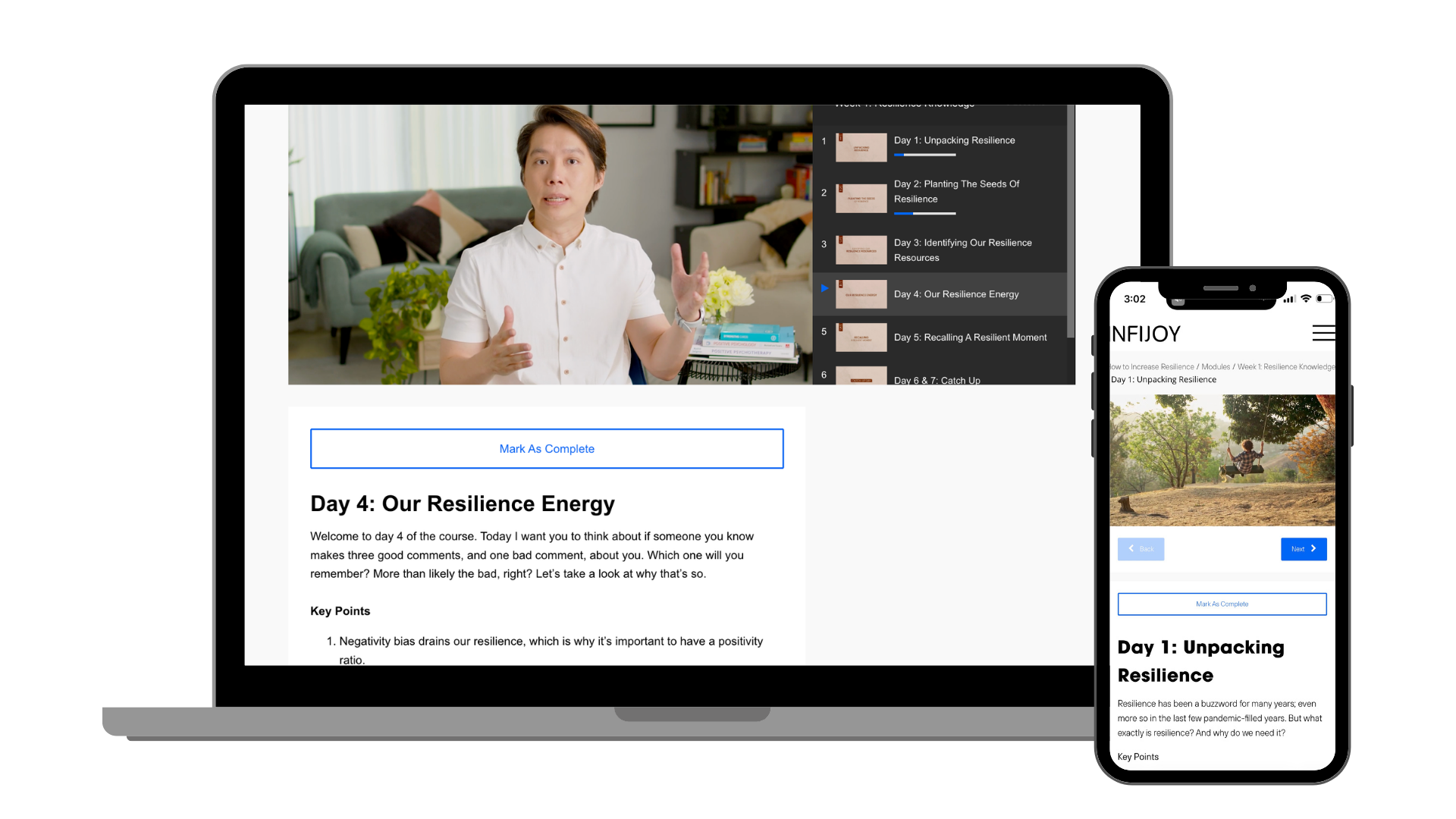
Knowledge first, then the emotional skill, then the awareness to catch a pattern, then the people around you, and finally the habits that keep all four available.
The art of bouncing back from challenges, developing emotional agility and fostering self-awareness. Week one equips you with tools to reframe thoughts, manage stress and build lasting connections, and sets up the more resilient version of yourself that the following four weeks develop.
Developing emotional intelligence and managing stress and difficult emotions are what build a robust emotional identity. These lessons cover techniques for improving emotional agility, working through body-mind connections, emotional awareness and a richer emotional vocabulary. Naming a feeling accurately turns out to be most of the work.
Building the resilience muscle by expanding conscious and unconscious awareness. The week covers reflection, cognitive reframing, diffusion and mindfulness, all aimed at one outcome: identifying an unhelpful thought pattern and being able to halt it rather than watch it run.
Interpersonal, intrapersonal and human-nature connection, and how our brains are wired to seek and form bonds. Social relationships supply safety, comfort, empathy and moral support, and they are a pivotal part of mental well-being. This week maps the structure of your own social resources and what each one is actually for.
Habit formation strategies for building and keeping well-being routines that protect your mental health. Through practising these techniques and applying what the previous four weeks covered, you finish with the tools to raise your resilience and to support yourself better during difficult periods.
If within the first two days you feel this is not the right fit, email support@infijoy.com and we will refund your enrolment fee in full, no questions and no forms.
Buy How to Increase Resilience outright, or join Infijoy membership for all 37 expert-led courses.
48-hour money-back guarantee · Instant access
$299.99 billed yearly · Cancel anytime · 7-day guarantee
Still unsure? Email support@infijoy.com and we will answer.
Yes, and that is the premise of the course. Much like physical strength, emotional and mental resilience are muscles that can be strengthened and used when needed most. The five modules train it as a capacity rather than describing it as a personality trait.
Six hours of on-demand learning in total, across 25 short lessons over five weeks. Each lesson comes with a daily task, and in a course about building a capacity those tasks matter more than usual.
It can help, and it is worth being clear about what it is. This is an educational course in building resilience, not therapy or crisis support. If you are struggling significantly, please speak to a doctor or a qualified mental health professional. A course like this works best alongside that kind of support rather than instead of it.
Across the five weeks you will:
Yes. Start whenever you are ready and work at your own pace. Lifetime access means you can return to a specific week when circumstances make it relevant again, which is how most people use this one.
None. No background in psychology is assumed, and every concept is built from the ground up.
Stephen is a certified psychotherapist, clinical hypnotherapist and a fellow of the National Council of Psychotherapists in the UK. He holds an MSc in Applied Positive Psychology from Anglia Ruskin University and a Postgraduate Diploma in Positive Organisational Psychology and Leadership. He is founder and CEO of The School of Positive Psychology in Singapore, has over eighteen years in psychological science, and has worked with more than 800 clients on resilience, trauma recovery and post-traumatic growth.
Lifetime access to all 25 lessons and the accompanying notes, so you can return whenever you need a refresher.
No. Stephen is a practising psychotherapist, but this is an educational course rather than clinical treatment. It is not therapy, diagnosis or treatment for trauma, anxiety, depression or any other condition, and it is not a substitute for care from a qualified professional.
Join How to Increase Resilience and spend five weeks training the capacity you have been relying on without ever being taught how it works.
48-hour money-back guarantee · Secure checkout · Instant access
Submit your email address below to get notified when we launch!