What Is Narcissism?
Mar 09, 2026
In Ancient Greek mythology, the story of Narcissus tells the tale of a man who was promised a wonderfully long and healthy life 一 as long as he never looked upon his own reflection. Gifted with extraordinarily good looks, Narcissus had many admirers whom he rejected repeatedly as he considered them unsuitable, or not worthy of his own affection. One of them, named Echo, was so heartbroken that she wasted away 一 so as punishment, the goddess Nemesis cursed him to fall in love with his own reflection until he, too, withered and died. The story explores themes of self-adoration and warns of the dangers of self-obsession一and it’s also what inspired the term “narcissist”.
The Exploring Narcissism Short Course unpacks everything you need to know about narcissism in short video modules.
At some point in your life, you may have come across someone who’s a little too much like Narcissus for their own good. Someone who’s a little too obsessed with their appearance, overly prideful of whatever they do, and who firmly believes that they are better than everyone else. And a lot of the time, this person is a narcissist.
In psychology, narcissism is defined as excessive self-love or egocentrism. While having self-love is essential for our mental health and self-esteem, self-obsession ー or having an overly inflated sense of self ー can be quite harmful. Extreme narcissism can lead to narcissistic personality disorder: a mental health issue encapsulating grandiosity, a need for admiration, and a lack of empathy. But where does this inflated self-image come from? Read on to learn about the psychology behind narcissism and narcissistic personality disorder, find out whether narcissists can change, and how to handle it if there’s one in your life.
Narcissism and Narcissistic Personality Disorder
What Is Narcissism?
According to the American Psychological Association, narcissism is defined as excessive self-love and egocentrism. Narcissism is a delusional sense of self-worth, wherein one’s idea of their grandiosity is much higher than that of an average person, and there is a lack of ability to recognize another person's point of view. Narcissists usually lack empathy and find it difficult to understand how another person might feel. For this reason, narcissists are often unaware of how their actions can affect others, and it can result in considerable damage to social relationships.
A narcissist’s admiration and appreciation of themselves is much higher than it is for other people. Narcissists have such an elevated view of their own ego that when choosing a romantic partner ー whether for a relationship or simply to satisfy their libido ー they tend to choose a partner who is as similar to themselves as possible. They also tend to have a sense of entitlement, believing that they are better than others and therefore deserve more. They may fantasize about unlimited power and success, believing that they are exceptionally worthy of it because they are special and unique.
What Is Narcissistic Personality Disorder?
When narcissism occurs to an extreme, this can lead to the development of Narcissistic Personality Disorder (also known as NPD), wherein one’s excessive self-love and egocentrism is so prevalent and persistent that it can affect everyday functioning. The American Psychological Association classifies NPD as a personality disorder, characterized by a pattern of a need for admiration. It is when one’s narcissism has become embedded into their personality and values, becoming so intrinsic that it’s very difficult for the person in question to let go of these qualities. The major difference between narcissism and NPD is that NPD can cause the individual to develop other considerably serious issues, such as emotional distress, or difficulty building and maintaining healthy interpersonal relationships.
The Two Types of Narcissism
Despite the dramatic nature of the Ancient Greek myth after which the condition is named, not all narcissists are quite as theatrical: it isn’t always as clear as the caricature of someone who can’t walk past a mirror without pausing to admire their own reflection (although that can happen). Narcissism comes in different forms and types, and not all of them are people who appear to be overly confident about themselves: people who are more reserved and introverted can also display narcissistic qualities. Displays of narcissism are often grouped into one of these two categories:
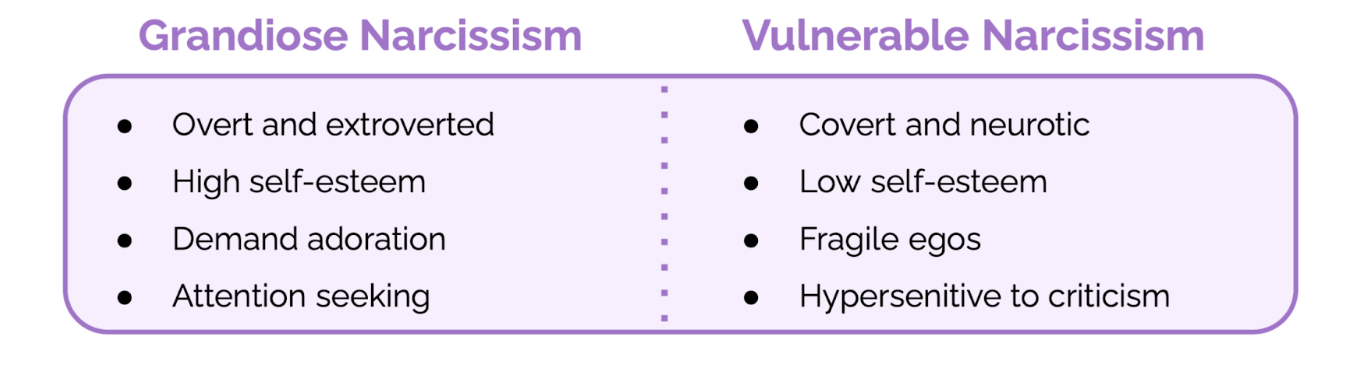
Grandiose Narcissism
This form of narcissism is characterized by extroversion, dominance, and attention-seeking. Grandiose narcissists tend to pursue attention and power over others, and usually seek power for status. Using the big five theory of personality, grandiose narcissists are people who have low agreeableness, high extraversion, and low neuroticism. Individuals who display grandiose narcissism usually internalize thoughts such as “I am better” and “I deserve more than others.”
In extreme cases, grandiose narcissists often believe they deserve to have whatever they desire without necessarily having to earn it, or face any other consequences around claiming it. They tend to show characteristics of impulsiveness, aggressiveness, arrogance, exploitative behavior, and entitlement, in addition to an exaggerated level of confidence in themselves. However, this can come at a cost: this unreasonably high self-confidence can damage social relationships, and most grandiose narcissists are unaware of or unconcerned with how their behavior affects the people around them.
Vulnerable Narcissism
This form of narcissism may not be what a stereotypical narcissist would appear to be一instead, they are often quiet and reserved. People with vulnerable narcissism tend to possess a strong sense of entitlement, and are easily threatened and hypersensitive. Within the traits of the big five theory of personality, they have low agreeableness, low extraversion, and high neuroticism. Vulnerable narcissists also often display instability with their identity. They can become hypersensitive when interacting with individuals they perceive to be better than them, suppressing their insecurities by using narcissism to protect their ego. This inflated ego is used to mask how deep down, they do not feel good about themselves and have a fear of being seen for who they truly are. Common characteristics of vulnerable narcissists include unstable emotions, a fragile ego, insecurity, entitled, inferiority, and defensive enviousness.
Causes of Narcissism
It is believed that narcissism can be influenced or brought on by both genetic and environmental factors. Below are some commonly-attributed causes.
- Genetic Factors: Narcissism can be an inherited trait, sometimes passed down from parents, which means people with family members or blood relatives who are narcissists are more likely to become one themselves. On a more specific level, one study found that certain characteristics indicative of narcissistic tendencies can be passed down: for instance, the research suggested that grandiosity was 23% heritable, while a sense of entitlement was 35% heritable.
- Brain Structures: In a study comparing the brain scans of people with NPD and those without it, the brain structure of narcissistic versus other types of people was found to be different. In particular, certain regions of the brain responsible for social behavior and emotional regulation were different. These differences could increase one’s tendency to focus on their own needs over those of other people, and change how they perceive or interpret social behaviors.
- Learned from Others: Narcissism can be a learned behavior, and the children of narcissistic parents can develop it by imitating them, even unwittingly. Without awareness of the issue, as well as an effort to unlearn then change this mimicked behavior, they can grow into arrogant adults who lack empathy.
- Individualistic Cultures: People raised in individualistic cultures are more likely to become narcissists, as this type of culture emphasizes the importance of one’s social status and achievement of individual success. Individualistic cultures generally place more emphasis on personal factors as they are more inclined to view each individual on a unique basis, and encourage self-expression. As a result, people from individualistic cultures are more likely to have a strong focus on the self一which, if taken to an extreme, could develop into narcissism.
- Parenting Style: The way parents treat their children can affect how likely they are to develop narcissistic behavior or not. Parents who often praise or over-praise their child, for instance, can increase their risk of developing narcissism, as they may grow up with a warped perspective of thinking that they are better than their peers. Extremely authoritative parenting can also increase a child’s tendency to develop a narcissistic personality, since this parenting style tends to over-evaluate a child and criticize them harshly and/or frequently without addressing areas of improvement. This could lead to insecurities that wind up being masked by vulnerable narcissism.

Symptoms of Narcissistic Personality Disorder
The most classic signs of a narcissist are a strong sense of entitlement and a high level of attention-seeking. Yet there is no singular list of what traits a narcissist may exhibit. Narcissism isn’t the same as NPD, either一a narcissistic person might not have NPD, but people with NPD are generally narcissistic. It exists on a spectrum, and almost everyone has some degree of narcissism一and that isn’t necessarily a bad thing. In our busy modern and fast-paced world, the occasional narcissistic traits we may all display from time to time can help: Take, for instance, having the confidence to proudly speak about your own top achievements in a job interview, and believe that you are absolutely worthy of landing the role, even if it’s a position that might have been slightly above your reach if you went by a humble assessment of the title alone. In certain circumstances ー such as performing on stage or in the entertainment industry, or having little to no shame in being your true self even if that’s quite different from the rest of your community ー having higher narcissistic tendencies can be a boon. In fact, one study found that people with narcissistic traits tend to be happier, tougher, and less stressed 一 to a reasonable degree, of course. When taken to an extreme, and when narcissism develops into NPD, it can be extremely harmful. The Diagnostic and Statistical Manual of Mental Disorders (DSM) lists several symptoms that people with NPD may present.
- Exaggerated Self-Appraisal: People with NPD often compare themselves to other people in order to regulate their self-esteem, for example by reinforcing their belief that they are superior to others. In grandiose narcissism, their self-appraisal can be inflated, whereas with vulnerable narcissism, it can be deflated.
- Self-Directed: NPD people are self-directed: most of the things they do are to satisfy their needs. It is not uncommon for narcissistic people to set goals simply to gain approval from others. They can also set unrealistically high or low standards to create situations where they may view themselves as exceptional compared to the average person. For instance, a narcissistic individual may join a sports team and push them to win, not because they are motivated by a belief in the team’s ability, or the desire to build stronger team spirit, but rather, a desire for fame and attention from others.
- Lack of Empathy: People with NPD have an impaired ability to recognize and identify other people’s feelings. This makes them often over- or under-estimate how their behavior will affect others. When a narcissist puts others down to feel better about themselves, they may not realize how their behavior can make the others feel bad.
- Lack of Intimate Relationships: Relationships with narcissistic people are usually quite superficial. In general, this is because narcissists have little interest in getting to know other people - particularly on a deeper level - as they are too focused on themselves. They may, however, decide to build connections with people for the sake of certain benefits, whether that’s to reinforce or boost their sense of self-worth, or further their career. Narcissists tend to avoid intimacy with their romantic partners, since they are afraid of being judged for their imperfections.
- Grandiosity: Grandiose behavior involves an irrational feeling of superiority, with feelings of entitlement. It can be either overt ー displayed explicitly, or covert ー not easily recognizable by other people. Entitlement can lead to self-centeredness and condescension towards others. Narcissists with this trait may believe they’re better looking and more intelligent than others.
- Attention-Seeking: Attention-seeking behavior is characterized by excessive attempts to attract the attention of others, and becoming the focus or centre of attention in various situations. Narcissists are also admiration-seeking. They tend to enjoy indulging in self-promoting behavior, and emphasizing their uniqueness.
Can a Narcissist Change?
Since it’s a part of one’s personality, it’s difficult for a narcissist to change. However, that doesn’t mean it’s impossible: there are several different approaches ー a lot of which are talk-based therapies ー that can be used to make narcissistic qualities more manageable. Yet their effectiveness depends largely on how committed the person is to change. The first step is for them to identify the issue, then become motivated to address it.
Although narcissists and people with NPD are usually unaware of these characteristics of theirs, they do tend to become more aware of it as they grow older. Below is a list of common treatment options for narcissism and NPD.
- Transference-Focused Therapy: This psychodynamic therapy method was initially used to treat borderline personality disorder. It is an active and interactive approach, wherein the therapist helps someone recognize their narcissistic personality and modify it. It also aims to discover the causes for the person’s narcissism, then helping them develop a more realistic and reasonable self-representation.
- Mentalization-Based Treatment: This treatment focuses on self-regulation and awareness of mental states in others. It is a unique approach that combines various concepts related to the psychodynamic, cognitive, and relational. The practice aims to increase the narcissist’s mentalization: an ability to reflect on others’ views as well as their own.
- Schema-Focused Therapy: This approach aims to work on the narcissist's schema – a cognitive framework that supports one means of organizing and interpreting information. Schema-focused therapy postulates that schema is the major reason that causes people to be narcissistic. The therapist will address the narcissist's schemas and reconstruct it to be less egocentric. Techniques like roleplay and interpersonal training are often used in this approach.
- Cognitive Behavioral Therapy: Like schema-focused therapy, cognitive behavioral therapy (CBT) focuses on the narcissist's thoughts. The CBT therapist educates the narcissist on the theory that thoughts influence behavior, and by changing their thought processes, narcissism can be manageable. This approach also uses worksheets and take-home assignments.
What Happens to People Who Are Around a Narcissist?
Interacting with a narcissist can be confusing, frustrating, and hurtful. Narcissists tend to be self-centered and lack empathy, making it very hard for others to feel equal when communicating with them. For example, narcissists tend not to listen when others are talking. Narcissism can negatively affect people in many ways, such as relationships and work.
Narcissists in Relationships
When it comes to dating, grandiose narcissists are very attractive to some, since they feel more comfortable showing off their social status. For example, they may buy luxury products to display their power to others. One study also found that narcissists are perceived as attractive as they tend to put more effort and time into their physical appearance. Yet, narcissists tend to have shallow relationships. They may avoid building closer and more intimate relationships with their partner.
In extreme cases, narcissists will also start dating someone for the purpose of boosting their own self-esteem. For instance, a narcissist may choose to date an attractive, popular, beautiful person who has many admirers, as a reflection of their own self-value. Narcissists are also more likely to be unfaithful in a relationship. They thrive on admiration, so when someone other than their partner shows affection towards them, they tend to cheat and betray their partner to display power in the relationship.
Narcissists in the Workplace
Grandiose narcissists are very good at promoting themselves as they typically have high self-confidence一a key quality that can make someone effortlessly pass a job interview. Yet, research suggests that narcissists in the workplace are more likely to show unethical behavior, such as sexual harassment, fraud, lying to employees, and even gaslighting. As a result, narcissists can leave their colleagues feeling frustrated.
In addition, narcissists are extremely self-centered. They tend to focus on personal gain rather than doing good for the team. When working with narcissistic people, they may take credit from and exploit colleagues, particularly if the workload is divided. A narcissistic boss may also benefit by giving too much work to their employees, making their employees feel burnt out at work.
How to Handle Narcissists?
It is not always easy to handle narcissists as they are highly self-centered and lack empathy. If you suspect that someone you know may be a narcissist and that it’s affecting your life, below are a few tips that can help you better handle the situation, and protect yourself.
- Find Out What Type Of Narcissist They Are: Dealing with narcissists can be tricky if you’re unsure of what makes them tick. Observing their behavior to try and identify what type of narcissist they are can help you learn to be flexible and change how you interact with them. For example, when interacting with grandiose narcissists, it’s worth considering that praising them more often may be enough to satisfy their self-esteem needs, so that they don’t try to seek it through other means with you. When talking to vulnerable narcissists, be careful of your word of choices, as they are highly sensitive and can start ruminating on that when they feel offended.
- Understand the Causes: Narcissistic qualities may develop from how someone was treated when they are young, such as through emotionally neglected childhood experiences, and may even speak to their hidden insecurities. Understanding the reasons behind their behavior can help you regain your patience and tolerance when you interact with a narcissist, and it may also offer you more insight into how to communicate with them more effectively.
- Listen to Your Gut: There’s absolutely no problem with the idea of learning to love yourself more. Self-love is an important aspect of mental health, after all. But the difference between self-love and narcissism is that narcissistic people tend to look others down in order to feel better about themselves. When communicating with a narcissist, it’s likely that they’ll say disrespectful or insulting things about other people or even you, to gain a sense of superiority and entitlement. Even if the narcissist you are dealing with is someone you are close to, it’s important to understand that their views are distorted. Narcissists typically only care about themselves, and what they are saying is not necessarily reflective of the truth. Pay attention to your intuition, and try not to let their words lead you to question your own self-worth.
- Set Boundaries: Due to their lack of empathy and sense of entitlement, narcissists may not realize how damaging their behavior is. If someone’s narcissistic behavior is having a negative impact on your mental health and how you feel about yourself, it’s time to set or maintain boundaries with them to regain your peace. Take a break or try to create some healthy space between you, whether they are in your workplace, your circle of friends, or even your partner. Limit the contact you have with them, and if nothing else is working, it may be worth reconsidering whether you should continue your interactions or relationship with them.
All of the content on our website is thoroughly researched to ensure that the information shared is evidence-based. For more information, please visit the academic journals that influenced this article: APA Dictionary of Psychology - Narcissism; What are Personality Disorders?; A Behavioral Genetic Study of Intrapersonal and Interpersonal Dimensions of Narcissism; DSM Criteria of NPD; Narcissistic Personality Disorder: Progress in Recognition and Treatment; Transference-Focused Psychotherapy (TFP) for Narcissistic Personality: Engaging Patients in the Early Treatment Process; Mentalization-Based Treatment for Pathological Narcissism; Could Schema Therapy Help Treat Narcissistic Personality?; Cognitive Behavioral Perspectives on the Theory and Treatment of the Narcissistic Character; Narcissism and Attractiveness; Why Do Narcissists Cheat So Much?