Why Learning Through Experience Is So Powerful
Dec 18, 2025
Do you have something you’ve always wanted to do but never did? Perhaps you’ve never felt like it was the right time to do it. Or maybe you’re scared that you will make mistakes along the way. Perhaps it’s just the fear of the unknown that’s holding you back. If so, you’re not alone. We all struggle with starting things, at times – especially when we’re about to start with something new. But if you truly want to achieve your goals and dreams, it’s important to try and let go of your fear of failure, and ditch your desire for “perfection” in each experience – because these thoughts can keep you stuck. And when it comes to experiencing things – particularly, new things – sometimes, the only way out is through!
Experiences – be it those that end in success or failure, or even exist simply for the state of being – are valuable for learning and helping us grow. The truly handy part about “learning by doing” is that the moment you start doing something (basically, anything!), you earn a new experience. In other words, the more you practice – even if you fail – the better you get. But have you ever wondered why experiential learning is so powerful? And how exactly does practicing something consistently – or simply gaining experience in it – strengthen your skill sets? Read on to find out what psychology says about the power of experience, how your experiences can change your brain, and how to make the most of them.
The Cognitive Science of Experience
Psychologists suggest that experiences not only offer us a chance to hone our skills but that they also have a secret power: they can actually change our brains. And this change can be so impactful that it can help anyone, including you, to become proficient at any task.
In 2000, Dr. Eleanor Maguire – a cognitive neuroscientist – showed the powerful impact that learning through experience could have on our brains in a famous study of the brains of London taxi drivers. As its name suggests, Dr. Maguire, together with her colleagues, invited taxi drivers in London to join their research. These taxi drivers had been driving for 14.3 years on average. All of them had been working as licensed taxi drivers for at least one and a half years.
In the study, Dr. Maguire and her colleagues compared the brain structures of these professional drivers with casual drivers and non-drivers. Specifically, they used structural magnetic resonance imaging (MRI) – a brain imaging tool – to scan their brains.
How Does Experience Change the Brain?
After analyzing the brains of the two groups – the taxi drivers and the non-taxi drivers – Dr. Maguire discovered a pattern: the taxi drivers’ posterior hippocampi were much larger.
The results immediately drew all the researchers’ attention because the posterior hippocampus is an area responsible for storing and processing spatial memory – information about our surrounding environments and space. So, this brain region is, in fact, essential for finding, remembering, and navigating directions.
Since driving a taxi requires a great sense of direction, along with the ability to navigate in an unfamiliar environment, the researchers suggested that the taxi drivers’ posterior hippocampus might be bigger because they have richer knowledge about the environment through their experiences. For instance, they learned from their regular training courses as well as from their day-to-day driving experiences. As a result, their larger-than-normal posterior hippocampus could give them more extraordinary navigational skills.
Practice Makes Perfect
The psychologists not only observed the brain structures between the two groups but also explored the correlation between how long they had been driving and their hippocampus sizes. In other words, the researchers examined how their time spent on training, and their years of experience working as a taxi driver, are related to their hippocampus size.
They found that the longer the taxi drivers’ driving experience, the bigger their posterior hippocampus. Non-taxi drivers, conversely, had a smaller posterior hippocampus size in general.
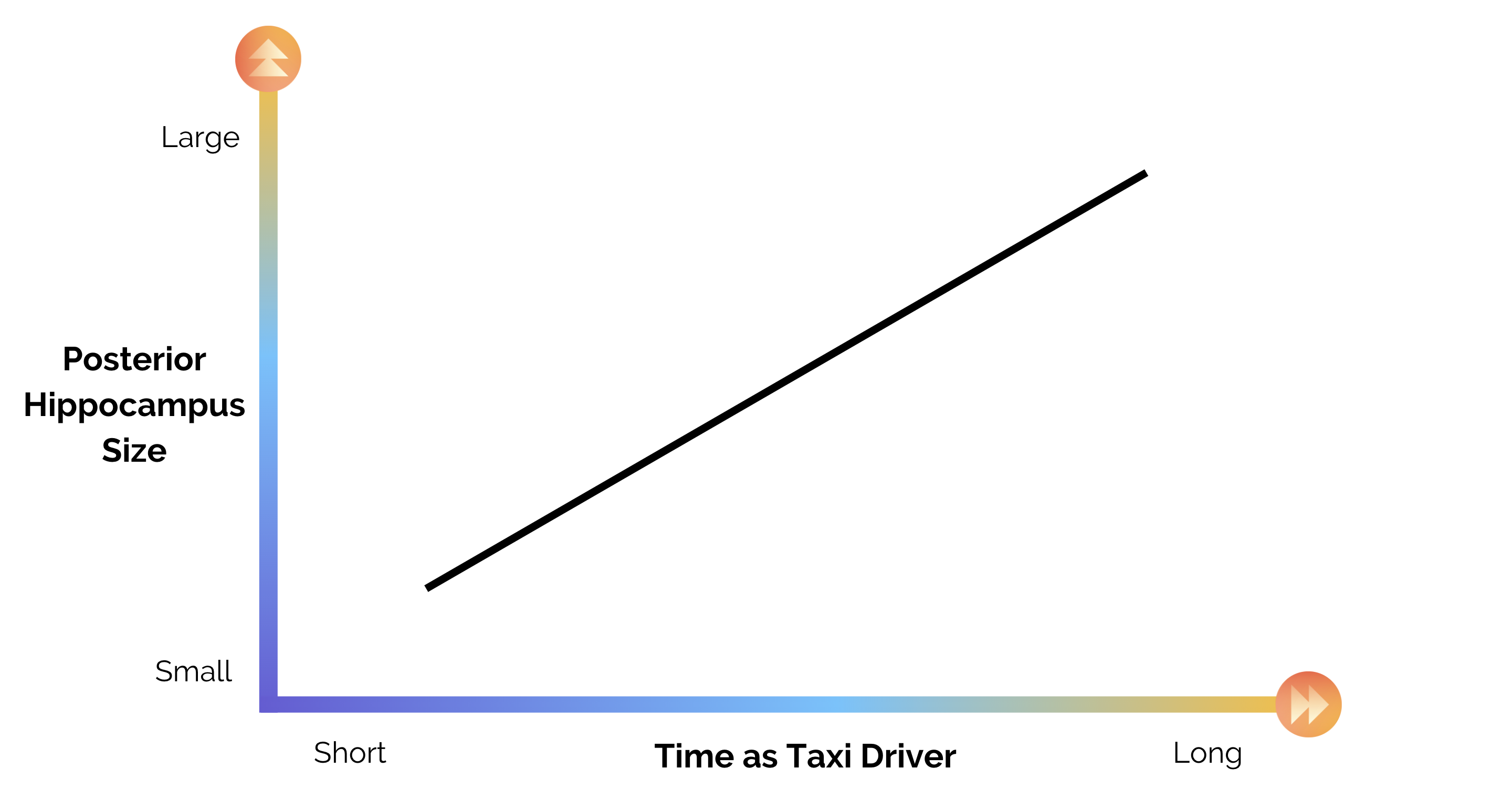
After seeing the results, the researchers suggested that there was a "mental map" in the taxi drivers' brains. Their findings showed that this "mental map" grows larger as a person gains more driving experience, making a professional driver's posterior hippocampus bigger than someone who doesn't drive.
And since our posterior hippocampus is responsible for navigating spatial information, the bigger posterior hippocampus size of taxi drivers might also indicate that their navigation skills are much better than those of ordinary people.
What London Taxi Drivers Teach Us About Experience?
Perhaps the taxi drivers’ bigger-than-usual posterior hippocampi were the results of their long years of dedication to driving. Or perhaps it can also happen the other way around. Unfortunately, the puzzle was not resolved, and this question remains unanswered.
But what this study taught us isn’t necessarily about how to become a London taxi driver. Rather, it’s that the more we practice a task, the more our brain changes to adapt, and the better we become at the job. And when we expose ourselves to new experiences – such as cultivating new friendships, or learning how language impacts our emotions – we can get better at it, as long as we practice our skills consistently. This is the power of neuroplasticity: the brain changes as we learn from experience.
The human brain is so powerful that it transforms its structure and function to help us adapt to new environments. And just as how the brain can change itself because of practicing driving, the brain can also change itself because of writing essays, drawing pictures, playing an instrument, starting a fitness routine, and speaking in public. So, are you ready to leave your comfort zone and learn from experience?
All of the content on our website is thoroughly researched to ensure that the information shared is evidence-based. For more information, please visit the academic journals and other resources that influenced this article: Prof Eleanor Maguire; Navigation-Related Structural Change in the Hippocampi of Taxi Drivers; Structural Magnetic Resonance Imaging | Science Direct; Functional Organization of the Hippocampal Longitudinal Axis; What Is Neuroplasticity?